



What Is Heat Treatment in Aluminum Profile Manufacturing? Complete Guide for Furniture Aluminum Extrusions
Contents
Heat treatment is one of the most important processes in the manufacturing of aluminum profiles. Whether you are sourcing furniture aluminum profiles, cabinet aluminum frames, wardrobe door profiles, sliding door aluminum extrusions, or custom industrial aluminum products, understanding heat treatment can help you evaluate product quality, strength, durability, and performance.
In this guide, we‘ll explain what heat treatment is, why it matters, the different types of heat treatment used in aluminum extrusion manufacturing, and which heat treatment processes are most suitable for furniture aluminum profiles.
What Is Heat Treatment in Aluminum Profile Production?
Heat treatment is a controlled process of heating and cooling aluminum alloys to alter their mechanical properties without changing their shape. The purpose is to improve characteristics such as:
- Strength
- Hardness
- Corrosion resistance
- Machinability
- Dimensional stability
- Wear resistance
- Formability
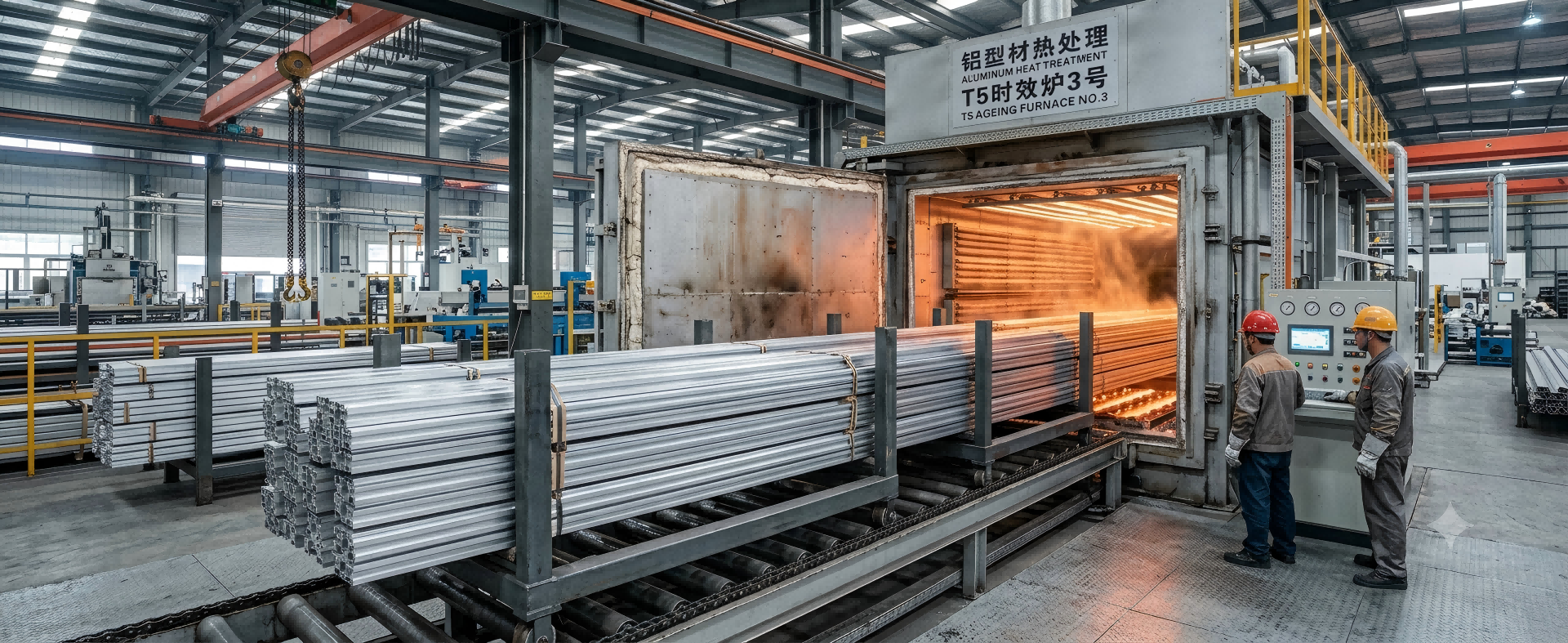
During aluminum extrusion manufacturing, the metal undergoes various temperature-controlled stages after extrusion. These thermal processes optimize the microstructure of the alloy, enabling the aluminum profile to achieve the desired performance for specific applications.
For example, furniture aluminum profiles used in kitchen cabinets, wardrobes, and sliding doors require a balance between strength, appearance, and processing performance. Heat treatment helps achieve these requirements.
Why Is Heat Treatment Important for Aluminum Profiles?
1. Increase Mechanical Strength
Heat treatment significantly improves tensile strength and yield strength, allowing aluminum profiles to withstand daily loads and structural stress.
2. Improve Hardness
Harder aluminum surfaces are more resistant to scratches, dents, and wear during transportation, installation, and long-term use.
3. Enhance Dimensional Stability
Heat treatment reduces internal stress generated during extrusion, minimizing deformation and improving dimensional accuracy.
4. Improve CNC Machining Performance
Many furniture aluminum profiles require drilling, milling, cutting, and punching. Proper heat treatment improves machinability and reduces tool wear.
5. Increase Product Lifespan
Heat-treated aluminum profiles maintain their structural integrity for years, making them ideal for modern furniture systems and architectural applications.
6. Support Surface Treatment Quality
Anodizing, powder coating, wood grain transfer, polishing, and brushing often perform better on properly heat-treated aluminum profiles.
Main Types of Heat Treatment for Aluminum Profiles
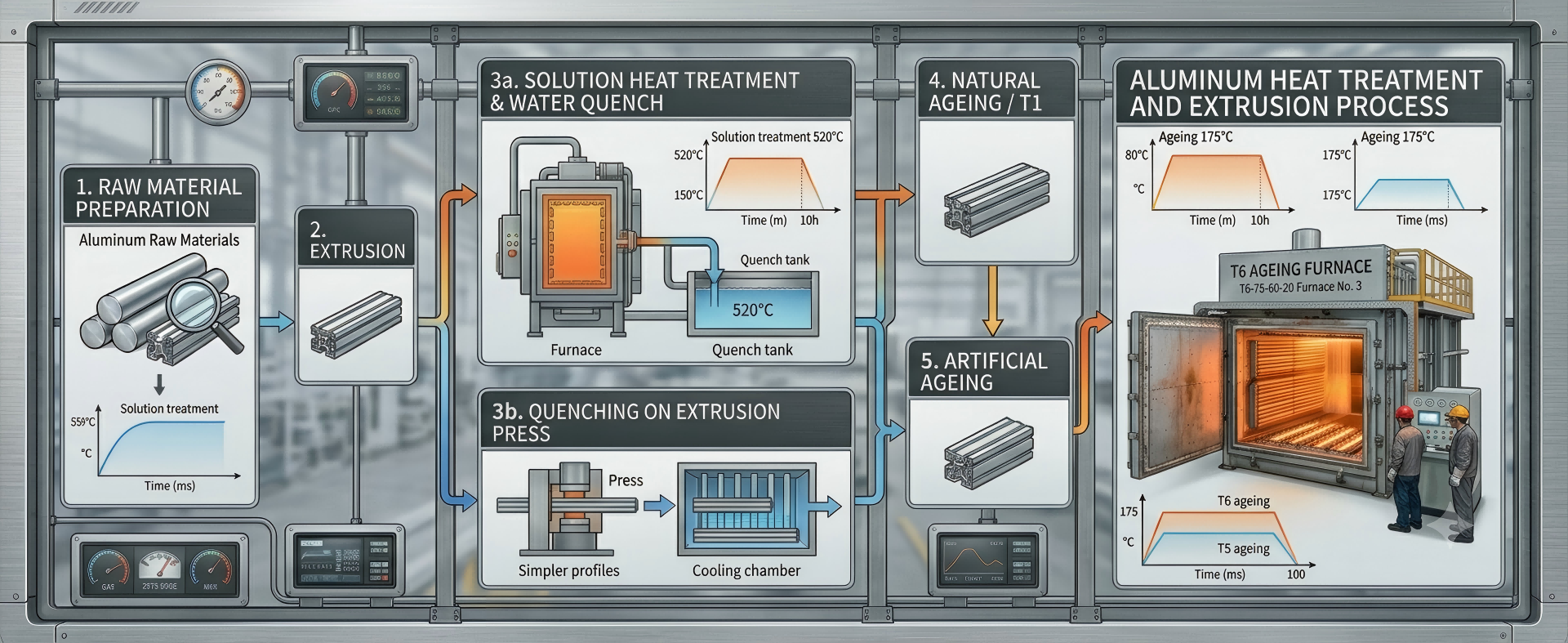
Different aluminum alloys require different heat treatment methods. The most common heat treatment processes include:
1. Annealing (O Temper)
Annealing involves heating aluminum to a specific temperature and slowly cooling it to reduce hardness and internal stress.
Characteristics:- Maximum ductility
- Excellent formability
- Lower strength
- Easy bending and shaping
- Complex profile forming
- Deep drawing components
- Special decorative aluminum parts
2. Solution Heat Treatment
This process heats the aluminum alloy to a high temperature, allowing alloying elements to dissolve into a solid solution.
Characteristics:- Prepares material for aging treatment
- Improves potential strength
- Creates uniform alloy structure
Solution heat treatment is commonly used for 6061 and 6063 aluminum alloys.
3. Quenching
After solution treatment, the aluminum profile is rapidly cooled using air, water, or mist cooling systems.
Benefits:- Retains dissolved alloy elements
- Prepares for aging process
- Improves final mechanical properties
4. Artificial Aging (T5 / T6 Treatment)
Artificial aging is the most important heat treatment process for aluminum extrusion manufacturers.
The profile is heated at a controlled temperature to precipitate strengthening particles throughout the aluminum structure.
Advantages:- Higher strength
- Improved hardness
- Better dimensional stability
- Excellent long-term performance
T5 vs T6 Heat Treatment: What‘s the Difference?
| Property | T5 Temper | T6 Temper |
|---|---|---|
| Process | Cooled from extrusion + aged | Solution treated + quenched + aged |
| Strength | Good | Higher |
| Cost | Lower | Higher |
| Production Efficiency | Faster | Slower |
| Typical Applications | Furniture Profiles | Structural Components |
Which Heat Treatment Is Used for Furniture Aluminum Profiles?
For most furniture aluminum profiles, manufacturers commonly use 6063-T5 and 6063-T6 temper conditions.
6063-T5
- Most popular for furniture applications
- Excellent surface finish
- Good strength-to-cost ratio
- Suitable for anodizing and powder coating
- Widely used in cabinets and wardrobes
6063-T6
- Higher mechanical strength
- Better rigidity
- Suitable for large sliding doors
- Suitable for heavy-duty furniture systems
For kitchen cabinet profiles, wardrobe frame profiles, glass door frame profiles, and decorative aluminum trims, T5 temper is generally sufficient and more economical.
Related Furniture Aluminum Profiles
- Wardrobe Aluminum Profiles
- Kitchen Cabinet Aluminum Profiles
- Sliding Door Aluminum Profiles
- Glass Door Frame Profiles
FAQ
What is the purpose of heat treatment in aluminum extrusion?
Heat treatment improves strength, hardness, dimensional stability, corrosion resistance, and overall product performance.
What is the difference between T5 and T6 aluminum?
T5 is cooled after extrusion and artificially aged, while T6 undergoes solution heat treatment, quenching, and aging, resulting in higher strength.
Which aluminum alloy is best for furniture profiles?
6063 aluminum alloy is the most widely used material for furniture aluminum profiles because of its excellent surface quality and extrusion performance.
Do all aluminum profiles require heat treatment?
Not all aluminum profiles require advanced heat treatment, but most architectural and furniture aluminum extrusions undergo T5 or T6 aging treatment to achieve required mechanical properties.
Does heat treatment affect anodizing and powder coating?
Yes. Proper heat treatment improves surface consistency and enhances the quality of anodizing, powder coating, wood grain transfer, polishing, and brushing processes.
Looking for High-Quality Furniture Aluminum Profiles?
We specialize in custom aluminum extrusion profiles for wardrobes, kitchen cabinets, sliding doors, glass doors, handles, decorative trims, and furniture systems.
✔ Custom Extrusion Dies
✔ 6063-T5 & 6063-T6 Aluminum Profiles
✔ CNC Machining Services
✔ Anodizing, Powder Coating & Wood Grain Finishes
✔ OEM & ODM Manufacturing

 8613602979735
 mail
mail